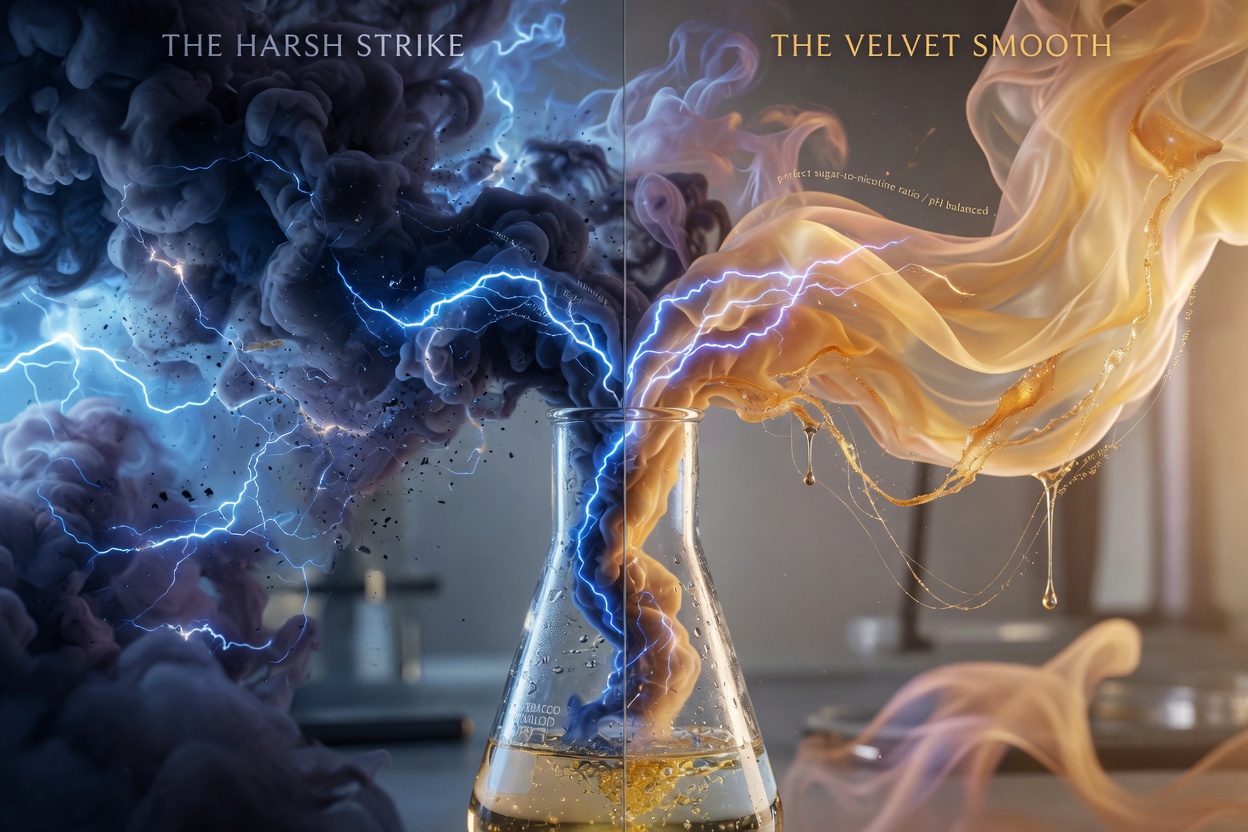
How the Ratio of Nicotine, Sugar, and Acid in Tobacco Blends Determines "Harsh" vs. "Smooth" — The Technical Logic
In the laboratory of a tobacco blender, the most fascinating elements are not the expensive flavorings, but the analyzers accurate to three decimal places. When discussing whether a cigarette is "harsh" or "smooth," outsiders may talk about taste, brand, or origin, but for those of us who deal with chemical compositions daily, this is essentially a precise game involving pH value, free nicotine ratio, and the Sugar-to-Nicotine Ratio.
I recall a late night in early 2016 at a tobacco R&D center in Yunnan. We were attempting to replicate a blended cigarette with extreme "smoothness." The nicotine content of that batch of experimental samples was quite ideal, but no matter how we adjusted the top dressing, the "throat irritation" during smoking never went away. It felt like drinking undiluted, unsweetened pure liquor — strong enough, but too "hard," completely lacking that mouth-coating "smooth" sensation. Later we realized the root of the problem was not the aroma but the acid-base balance of the smoke.
The "Two Faces" of Nicotine: Freebase and Protonated
To understand "harsh" versus "smooth," one must first see through the physicochemical state of nicotine.
Nicotine does not exist in a single form. In smoke, it primarily exists in two forms: freebase and protonated (salt form), depending on the pH value of the smoke.
When smoke is alkaline (high pH, e.g., above 7.0), nicotine exists more in its freebase form. Freebase nicotine is highly volatile — upon entering the mouth and throat, it is rapidly absorbed through the mucosa, creating an instant concentration impact that directly stimulates nerves, producing a strong, penetrating "kick." This is what we commonly call "harsh."
Conversely, by adding organic acids or using high-sugar tobacco leaves to lower the smoke pH (to a weakly acidic environment between 5.5 and 6.5), nicotine becomes "protonated" and transforms into nicotine salt. Salt-form nicotine has reduced volatility, and the absorption process becomes much gentler. It is no longer a sudden burst but a slow, sustained satisfaction. This sensory experience brought about by the change in chemical form is the underlying logic of "smooth."
Sugar-to-Nicotine Ratio: The Yardstick of a Blend's Soul
In practical operations, we have a core criterion: the sugar-to-nicotine ratio.
The calculation is straightforward: total water-soluble sugar content divided by total alkaloid (mainly nicotine) content. This is an extremely sensitive indicator that directly determines the "texture" of the smoke.
Based on my experience, a high-quality flue-cured tobacco blend typically maintains a sugar-to-nicotine ratio between 8 and 12. When it approaches 10, the smoke presents an excellent sweet, moist sensation with moderate impact. If this ratio falls below 7, such as when processing high-nicotine Burley tobacco, the smoke becomes exceptionally "dry, harsh" and aggressive — that "harsh" feeling makes prolonged continuous smoking unbearable.
In pursuit of extreme smoothness in blended cigarettes, we artificially raise this ratio by adding reducing sugars or glucose. In a 2019 experiment, we increased the sugar-to-nicotine ratio of a certain batch from 5.2 to 9.5. This single parameter change transformed sensory panel evaluations from "throat-irritating, rough" to "mellow, smooth."
The "Lubricating" Role of Acid
If sugar provides the "sweet, moist" foundation, then acid is the "lubricating" medium.
The organic acids we commonly use, such as citric acid, malic acid, or tartaric acid, play a crucial role in the casing process. Acid does more than simply lower pH — it acts as a buffer. Through the addition of acid, we not only convert nicotine into a milder salt form, but also produce more delicate aromatic substances through chemical reactions during combustion, thereby masking the inherent harshness of the tobacco leaf.
In blend design, acid addition must be extremely precise. Too much acid makes the smoke "sharp" with an obvious sour taste, destroying the tobacco's inherent mellow character; too little acid fails to effectively suppress nicotine's stimulant effect. It is like mixing a complex cocktail — the balance of acidity determines the dimension of the overall flavor.
Technical Logic in Practice: Parameter Examples for Three Typical Styles
To illustrate these principles more intuitively, I have compiled parameter models for three different design targets. Note that these values are typical ratios based on laboratory simulations; actual production is affected by the leaf source, moisture content, and burn rate.
1. "Heavy Hitter" Style
Target: Pursuing ultimate satisfaction, strong throat impact, and high nicotine delivery efficiency.
- Core Parameters:
- Sugar-to-Nicotine Ratio: 4.5 – 5.5
- Expected pH: 7.2 – 7.5 (alkaline)
- Nicotine Content: 2.8% – 3.5%
- Dressing Strategy: Minimal sugar, almost no organic acids, sometimes trace ammonia compounds to further raise pH.
- Sensory Profile: Instant pressure sensation upon entering the mouth, dense smoke with strong penetration, suited for those seeking a powerful "kick."
2. "Velvet Smooth" Style
Target: Pursuing extreme smoothness, sweet aftertaste, and minimal irritation.
- Core Parameters:
- Sugar-to-Nicotine Ratio: 11.0 – 13.0
- Expected pH: 5.8 – 6.2 (weakly acidic)
- Nicotine Content: 1.2% – 1.8%
- Dressing Strategy: High proportion of reducing sugars (glucose, honey) combined with appropriate citric or malic acid, supplemented with glycerin for moisture retention.
- Sensory Profile: Smoke glides over the throat like silk, almost no physical nicotine stimulation, distinctly sweet aftertaste, suitable for long, relaxed social occasions.
3. "Modern Balanced" Style
Target: Finding the golden ratio between satisfaction and comfort, suitable for the mass consumer market.
- Core Parameters:
- Sugar-to-Nicotine Ratio: 8.5 – 10.0
- Expected pH: 6.5 – 6.8 (neutral to slightly alkaline)
- Nicotine Content: 2.0% – 2.4%
- Dressing Strategy: Moderate sugar spray combined with trace organic acids for pH adjustment, plus a small amount of licorice extract to enhance aroma depth.
- Sensory Profile: Clear satisfaction without discomfort, mellow smoke with distinct layering.
Conclusion: The Ultimate Practice of a Blender
Blending is never a simple accumulation of numbers, but a respect for and utilization of natural chemical laws. By adjusting nicotine's form, manipulating the sugar-to-nicotine ratio, and balancing the subtle differences of acid and base, we ultimately create the art of "harsh" and "smooth" within the confined space of smoke.
Behind every successful blend are countless repeated pH measurements and the ultimate capture of sensory details. When you truly understand the dance of these chemical molecules, you will realize that what we call "good smoking" is nothing more than a perfect reconciliation between science and the senses.