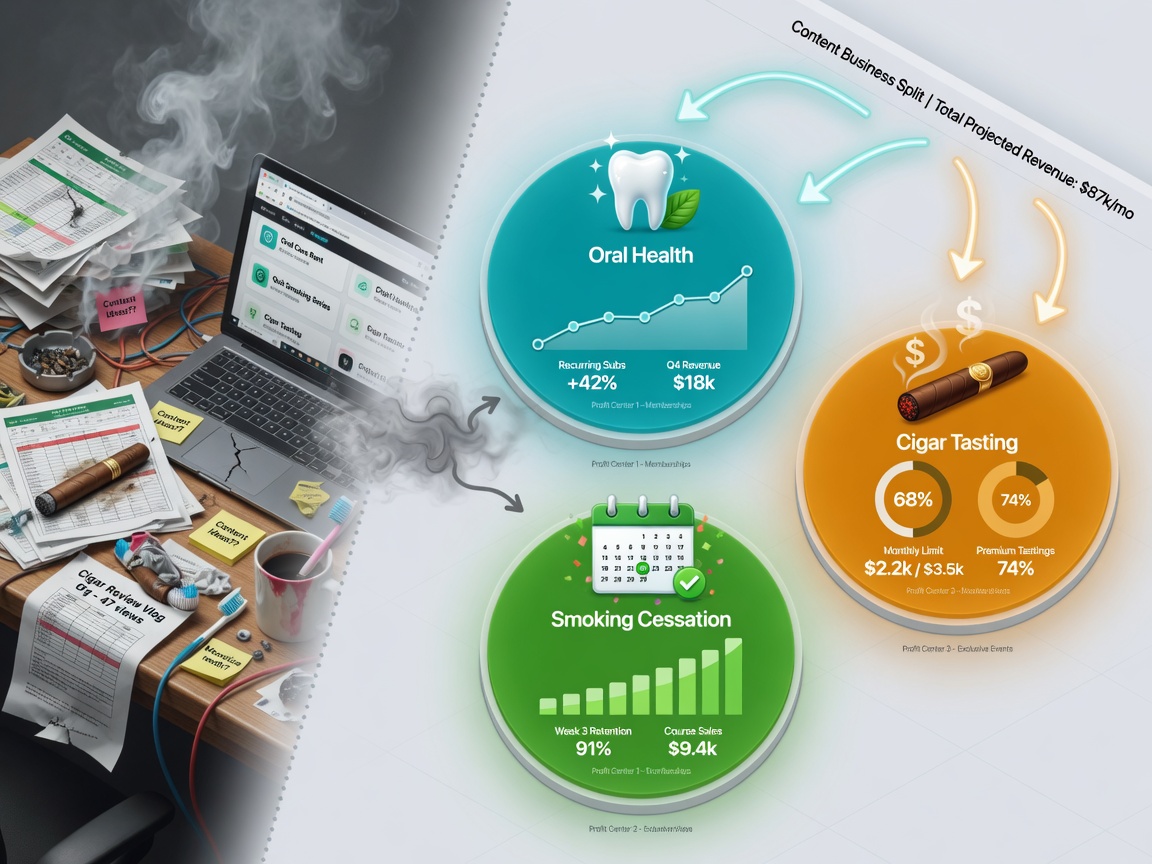
Splitting a tobacco content account into multiple profit centers is acknowledging: under the same narrative, user intents differ, and money flows differ even more.
Oral health is like a water bill, cessation methods like project payments, cigar tasting like an ad budget — you must listen with three ledgers.
# How to Split Your Tobacco Content Account into Multiple Profit Centers for Independent Accounting
At 10:21 PM on November 3, 2024, I was reconciling accounts in a rented room in Yangpu, Shanghai. The Excel sheet had only one line — "November Total Income: 18,640 yuan" — and below it, costs were a mess: editing outsourcing, Canva subscription, material pack printing, oral care product samples, smoking cessation community assistant hourly wages, two cigar samples for on-camera use (self-funded, mixed into "content costs").
At the time, I thought, "This month is okay." Three days later, I split the orders by source tags and discovered:
| Column | Estimated Contribution | Direct Traceable Cost | Gross Margin |
| Oral Health | 4,280 yuan | 1,150 yuan | +3,130 |
| Smoking Cessation | 11,900 yuan | 6,800 yuan (incl. assistant + refunds) | +5,100 |
| Cigar Tasting | 2,460 yuan | 3,210 yuan (samples + shooting + almost no conversions) | -750 |
|---|
The cigar line had hit 42,000 views on a single post on Xiaohongshu the previous month. I prioritized it based on view counts, only to find I was subsidizing a "looks professional" vanity with actual profits. From that day on, I set a rule: Only a content line that can independently state "how much I earned this week and why" qualifies as a profit center; otherwise, it's just a hobby or brand makeup.
In management accounting, a profit center is an internal unit responsible for both revenue and related costs, with its own P&L statement. Creators don't need SAP, but you must apply the same logic at the column level — otherwise, you'll forever use a "good-looking total ledger" to hide "one line bleeding."
1. Why Tobacco Accounts Are Especially Prone to "Mixed Books"
Tobacco-related content naturally tends to blur together: oral health topics lead to smoking discussions, cessation leads to nicotine, and tasting piggybacks on "flavor culture." Platforms impose strict restrictions on tobacco and nicotine advertising, so monetization often deviates to material packs, communities, consulting, oral care, and cessation support services — few revenue categories but diverse content themes, and diversity leads to mixed books.
Three pitfalls I experienced:
Cigar videos had higher average completion rates, so I prioritized them for editing. The result: from September to October 2024, the cigar line's direct costs were about 5,800 yuan, with only about 3,100 yuan in confirmed orders, mostly low-priced materials, plus higher compliance script costs.
When my WeChat Official Account + Enterprise WeChat totaled 6,300 people, I was quite proud. By source breakdown: smoking cessation intent ~58%, oral health ~27%, cigar interest ~15%. In the latter two categories, the density of people willing to pay for services was an order of magnitude lower. Total count is a vanity metric.
I once split the 799 yuan/month editing outsourcing equally across three lines. In reality, long-form cessation articles barely needed that type of production, while oral health short videos consumed over 60% of the work hours. After equal allocation, the cessation line's gross margin was artificially suppressed, and I almost cut the delivery-type content that later proved most profitable.
Personal view:
Tobacco content accounts don't lack "things to write about"; they lack refusing to make decisions with an average. Splitting into profit centers isn't about pretending to be financially professional — it's about putting every ounce of effort into "recoverable" intent in a space where ad slots are restricted.
2. Profit Centers in a Creator Context: How I Define It
For me, a column must simultaneously meet these criteria to become a profit center:
It does not mean immediately registering three separate companies, nor does it require physical separate accounts. Before January 2025, my three lines still operated under the same main account, using "content tags + conversion link codes" for virtual splitting; starting in February, I diverted cigar-interested users to a sub-account, narrowing the main account to "Oral Health + Cessation." Separate accounts are a result, not a starting point.
I recommend three splitting axes, not "platform" or "update frequency":
| Axis | Oral Health | Smoking Cessation | Cigar Tasting |
| User Intent | Symptom relief / care / checklists | Quit nicotine, endure withdrawal | Flavor, ritual, appreciation knowledge |
| Main Monetization Path | Low-cost checklist packs, care advice, clinic/consulting referrals | Communities, staged courses, 1v1 reviews | Tasting notes, offline events (compliant), cultural paid content |
| Compliance Risk | Relatively low (still avoid exaggerating efficacy) | Medium (avoid prohibited efficacy claims) | Higher (easily touches tobacco promotion red line) |
Different intents, different revenue paths, different costs of failure — if these three aren't separated, your books will always be a mess.
3. Oral Health: Low Ticket, Short Decision Chain — Best as a "Pipeline" Profit Center
3.1 How I Operate It Independently
Starting June 2024, I fixed the oral health line as "3 short videos per week + 1 long checklist per month":
A small offline sharing session in Hangzhou (August 17, 2024, a co-working meeting room in Binjiang, 19 attendees) confirmed for me: oral health users want executable check actions, not tobacco flavor stories. In the 48 hours after the event, 31 checklist packs were sold at 19.9 yuan each, with 0 refunds.
3.2 Accounting Categories (What I Actually Use)
Revenue
Direct Costs
Do Not Include
3.3 January 2025 Sample P&L (Simplified Actual Structure)
| Item | Amount (yuan) |
| Material Pack Revenue | 3,640 |
| Light Consulting Revenue | 1,200 |
| Total Revenue | 4,840 |
|---|---|
| Design / Layout Outsourcing | 400 |
| Fees + Refunds | 180 |
| Direct Costs Subtotal | 580 |
| Contribution Margin | 4,260 |
| Allocated Public Costs (see Section 5 formula) | 920 |
| Column Operating Profit | ~3,340 |
3.4 KPIs I Set for the Oral Health Line
My take:
Oral health is rarely highly profitable, but it's like running water. It's best suited to provide stable cash flow + trust foundation. If you only have one account, oral health content should be prioritized for "weekly updates without fail," rather than waiting for inspiration.
4. Smoking Cessation Methods: High Ticket, Heavy Delivery — Must Be Accounted on a "Project Basis"
4.1 Independent Operation Logic
The cessation line was my biggest profit contributor in Q4 2024, and also the heaviest in refunds and emotional labor.
Operation rhythm:
On December 9, 2024, the second 21-day camp started with 47 sign-ups and about 9,300 yuan collected; after accounting for assistant + my time costs, many would be shocked — if you don't count your own time, you'll misjudge "cessation camps are easy money."
4.2 Income and Costs Must Be Split to "Each Session"
I create sub-accounts for "each training camp / each month of consulting" and then aggregate to the column monthly report.
Revenue
Revenue, consulting, upgrade differentials
Direct Costs
December 2024 Cessation Line Simplified P&L
| Item | Amount (yuan) |
| Camp + Consulting Revenue | 14,200 |
| Refunds | -1,380 |
| Net Revenue | 12,820 |
|---|---|
| Assistant | 2,400 |
| Tools & Materials | 320 |
| Host Delivery Hours (28h × 120) | 3,360 |
| Direct Costs | 6,080 |
| Contribution Margin | 6,740 |
| Allocated Public Costs | 1,850 |
| Operating Profit | ~4,890 |
If you don't account for "your own 28 hours," the profit would inflate to over 9,000, then in January you'd overwork yourself, delivery quality drops, and February refund rates rise — I suffered this in January 2025, with refund rates hitting 14%.
4.3 KPIs — No Vanity Metrics
My take:
The cessation line is a "heavy-asset service" within profit centers. It can be profitable, but requires project-based thinking: only open when full, merge if not full, never accept unlimited 1v1 just because content went viral. My hard threshold: when monthly consulting bookings exceed 16, stop accepting new ones, route to queue or assistant pre-screening.
5. Cigar Tasting: Traffic Can Look Good — Default as "High-Risk Content Center," Only Upgrade to Profit Center When Qualified
5.1 Why I Once Miscalculated It
Cigar content is easy to make look polished: editing, lighting, table settings, origin stories. When a single post hit 42,000 views in October 2024, I treated it alongside oral health and cessation as "three pillars." Independent accounting revealed a simple truth: views don't pay royalty fees, but samples and your evenings do.
More critically, boundaries:
5.2 How My Positioning Evolved
| Phase | Positioning | Rules |
| 2024.7–10 | Misjudged as profit pillar | 2 posts/week, no budget cap |
| 2024.11–12 | Downgraded to brand/interest content center | Monthly budget cap 800 yuan; prohibited from using assistant resources |
| From 2025.2 | Sub-account + strict compliance scripts | Main account only retains "harm boundary explanation" cross-links; sub-account independently accounted |
Conditions for upgrading back to profit center:
5.3 Sample P&L (Loss Month, Deliberately Kept)
| Item | Amount (yuan) |
| Paid Notes / Small Materials | 860 |
| Samples & Props | 1,400 |
| Dedicated Shooting Outsourcing | 900 |
| Operating Profit | ~-1,440 (already negative before allocation) |
|---|
My take:
Cigar tasting can exist and even cultivate aesthetics and differentiation, but by default, it should not compete for the same conversion scripts with cessation users. You want flavor narratives; they want to avoid relapsing tonight — conflicting intents harm both sides' trust. The value of independent accounting is first allowing you to say, "I'm maintaining this line, but with a budget cap."
6. How to Allocate Public Costs: The Formula I Use
Public costs include: domain and knowledge store base fees, shared design subscriptions, phone depreciation, main account advertising (if any), accounting/invoicing, editing subscription that can't be precisely attributed to columns, etc.
The two-factor allocation I use since 2025:
\[
AllocationWeight_i = 0.5 \times \frac{ColumnDirectHours}{TotalDirectHours} + 0.5 \times \frac{ColumnNetRevenue}{TotalNetRevenue}
\]
Then:
\[
PublicCost_i = MonthlyPublicCostPool \times AllocationWeight_i
\]
The rationale is simple: allocating only by revenue penalizes new lines being invested in; allocating only by hours lets "high-revenue, low-production" lines freeload. The 50/50 split is my compromise after three months of testing — you can change the weights, but must lock them for a full quarter before adjusting, otherwise allocation itself becomes a profit-manipulation toy.
January 2025 Public Cost Pool Example: 4,200 yuan
Assuming hours: oral health 35%, cessation 50%, cigar 15%;
Net revenue: oral health 28%, cessation 65%, cigar 7%.
Then cessation weight ≈ 0.5 × 0.50 + 0.5 × 0.65 = 0.575 → allocation ~2,415 yuan.
Oral health ≈ 0.5 × 0.35 + 0.5 × 0.28 = 0.315 → ~1,323 yuan.
Cigar ≈ remainder.
You'll see: once cigar revenue doesn't rise, post-allocation losses become more glaring — that's exactly the signal I want.
7. From Mixed Books to Three Statements: My 7-Day Implementation
Tools: Feishu multidimensional table or Excel is fine. Don't jump to ERP on day one.
Day 1 (~2 hours)
List every revenue entry from the past 60 days, force-label: `Oral / Cessation / Cigar / Unattributable`. If unattributable exceeds 15%, your links and scripts lack source awareness — first fix order notes and form fields.
Day 2
List costs, label what you can; the rest goes to "public pool."
Day 3
Create three column monthly tables with at least: Date | Summary | Revenue | Direct Cost | Hours | Source Channel | Notes (refunds/complaints)
Day 4
Write the allocation formula, calculate last month's three-column operating profit. Print or screenshot, stick by the monitor — I did, and it worked.
Day 5
Set monthly budget cap and stop-loss line for each column. For example, cigar: samples + outsourcing combined > 1,000 and profit < 0 → automatic frequency reduction.
Day 6
Adjust content scheduling: sort by last month's operating profit, not by views. The first time I did this, oral health went from 2 to 4 posts per week, cigar from 2 to 0–1.
Day 7
Draft a "cross-column traffic rule":
Traffic direction is part of profit center governance, not a casual "mention."
8. After Independent Accounting: How I Do Addition and Subtraction
Accounting isn't to make tables look good — it's for ruthless decision-making.
That's how the cigar line was handled.
For the cessation line, I prioritized adding assistants, not writing more scare articles.
The oral health line switched from "high-end production editing" to "templated short videos," immediately slimming the public pool.
If any line is penalized for tobacco promotion language, that month's operating profit is counted as 0, and an incident review is opened — I'd rather have ugly books than trade account lifespan for one month of vanity revenue.
In February 2025, I changed the main account's one-liner to: "For those who want to care for their oral health and seriously quit smoking." Cigar interest was explicitly diverted. Follower count dipped temporarily, but private domain paid density actually rose — in March 2025, combined cessation + oral health operating profit was about 22% higher than January (same measure, including own work hours).
9. Your Checklist for This Week
Splitting a tobacco content account into multiple profit centers is fundamentally about acknowledging one thing: Under the same smoky narrative, user intents differ, and the way money flows differs even more.
Oral health is like a water bill, cessation methods are like project payments, and cigar tasting is often an ad budget. You can speak with one account, but you must listen with three ledgers.
When the ledgers are clear, scheduling, hiring, pricing, and sub-account decisions will shift from emotional choices to business decisions.
Profit center = internal unit responsible for both revenue and related costs
Two-factor allocation = 50% hours share + 50% net revenue share